Bifold Door Repair · Greater Manchester & Cheshire
Bifold door repair in Greater Manchester
Aluminium, uPVC and timber bifolds repaired across Greater Manchester and nearby Cheshire.
Rollers, hinges, tracks, shootbolts and traffic-door locks — diagnosed from your photos, priced before the visit, and fixed without selling you a new door.
A bifold set that drags, drops or will not lock almost always has a worn roller, a loose or worn hinge, debris in the track, or a traffic door that has dropped out of line with its keeps. These are adjustable or replaceable parts. LockMend repairs them across Greater Manchester and nearby Cheshire, with the price agreed from your photos before the visit.
What your bifold is doing — and what usually causes it
Eight symptoms cover nearly every bifold call-out. Each one points to a different part, which is why a photo is usually enough to price the job.
Track and rollers
Drags, grinds or needs a shove to slide
Likely cause: Grit in the bottom track, or a roller that has worn flat or collapsed under the weight of the glass.
Usual fix: Clean the track first. If it still drags, the roller carriage is replaced and the leaf re-levelled.
Traffic door
Handle is stiff, won't lift or the door won't lock
Likely cause: The traffic door has dropped a few millimetres, so the locking points miss their keeps. Sometimes the gearbox itself has failed.
Usual fix: Realign the leaf and reset the keeps. A failed gearbox or handle is replaced like-for-like.
Shootbolts
One panel will not bolt top or bottom
Likely cause: A shootbolt is bent or seized, or its keep in the track has moved or filled with debris.
Usual fix: Free or replace the shootbolt, clear and reposition the keep, then check the leaf height.
Alignment
Uneven gaps or a wedge of light at the top
Likely cause: Hinges or carriages have worn or worked loose, or the frame has moved since fitting.
Usual fix: Adjust carriages and hinges until the gaps are even, then re-test every leaf open and closed.
Folding
Panels won't fold flat or stack fully
Likely cause: A hinge is bent or cracked, a magnetic catch is misaligned, or a leaf is binding on the track.
Usual fix: Replace the damaged hinge and set the stack so each leaf parks without strain.
Off the track
A leaf has jumped the track or hangs at an angle
Likely cause: A carriage, guide or hinge has failed, or the leaf was forced while a bolt was still engaged.
Usual fix: Stop using the set. The leaf is secured, the failed part replaced and the set re-hung and aligned.
Weather
Draught, rattle or water at the threshold
Likely cause: Leaves no longer compress the gaskets evenly, or the drainage slots in the threshold are blocked.
Usual fix: Realign so the seals compress, clear the drainage, and replace gaskets only if they are torn or shrunk.
Seasonal
Only sticks on hot days
Likely cause: Aluminium expands in heat. A set fitted with tight clearances starts rubbing in summer sun.
Usual fix: Re-set clearances across the set. New parts are rarely needed for this.
Diagnostic note
If the handle on the traffic door is fine when the door is open but stiff when it is closed, the lock is not broken — the door has dropped. The locking points are rubbing on their keeps. Replacing the lock will not fix it; realigning the leaf will.
How a bifold works
The nine parts that keep a bifold folding, sliding and locking
A bifold is a row of heavy glazed leaves hinged together and running in a track. When one part wears, the others take the strain — so we check the whole set, not just the leaf that sticks.
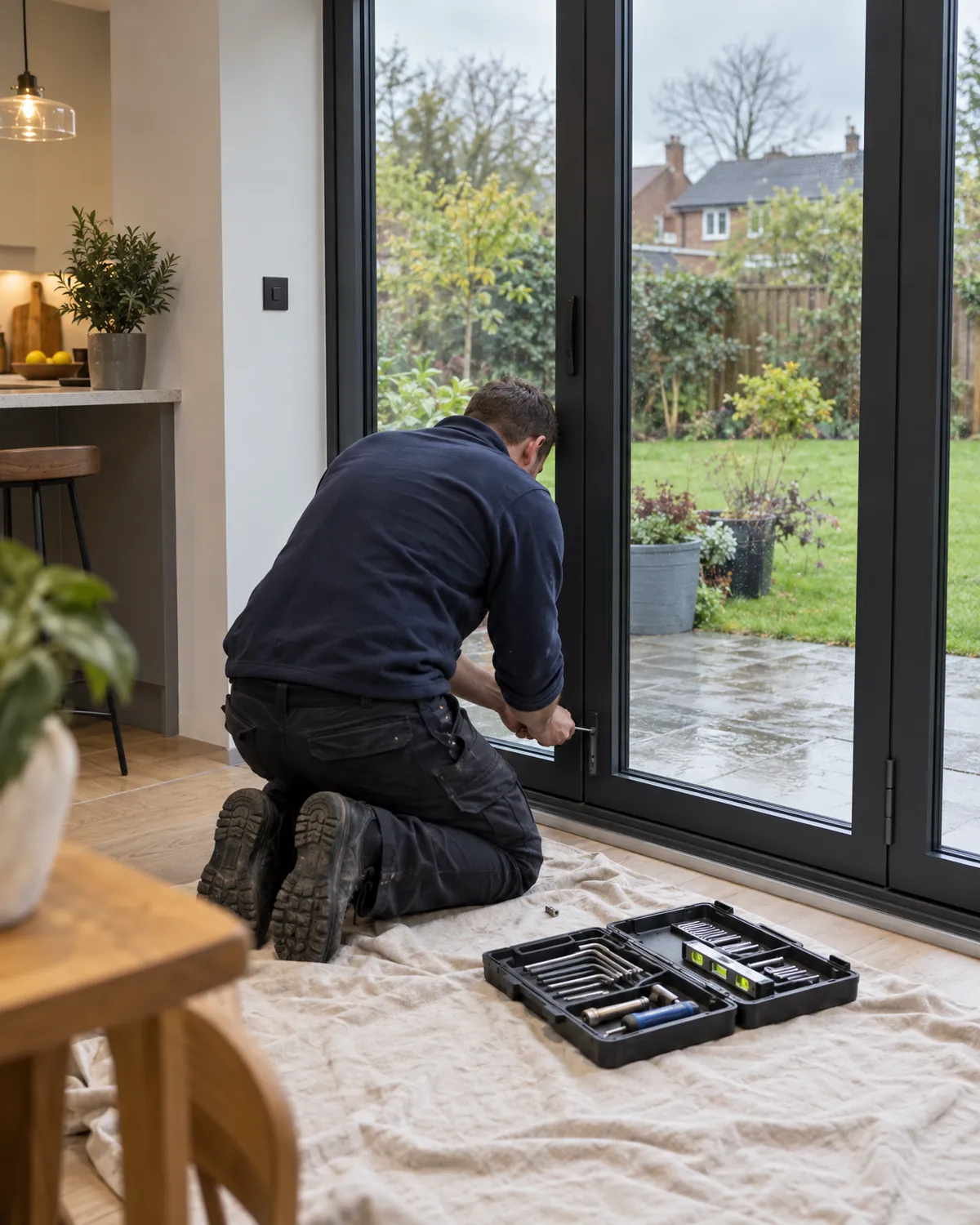
Three-panel set, viewed from inside: a traffic door on the left and a folding pair on the right.
1
Top track
Guides the panels — or, on top-hung systems, carries their full weight. The beam above it must stay straight.
2
Roller carriage
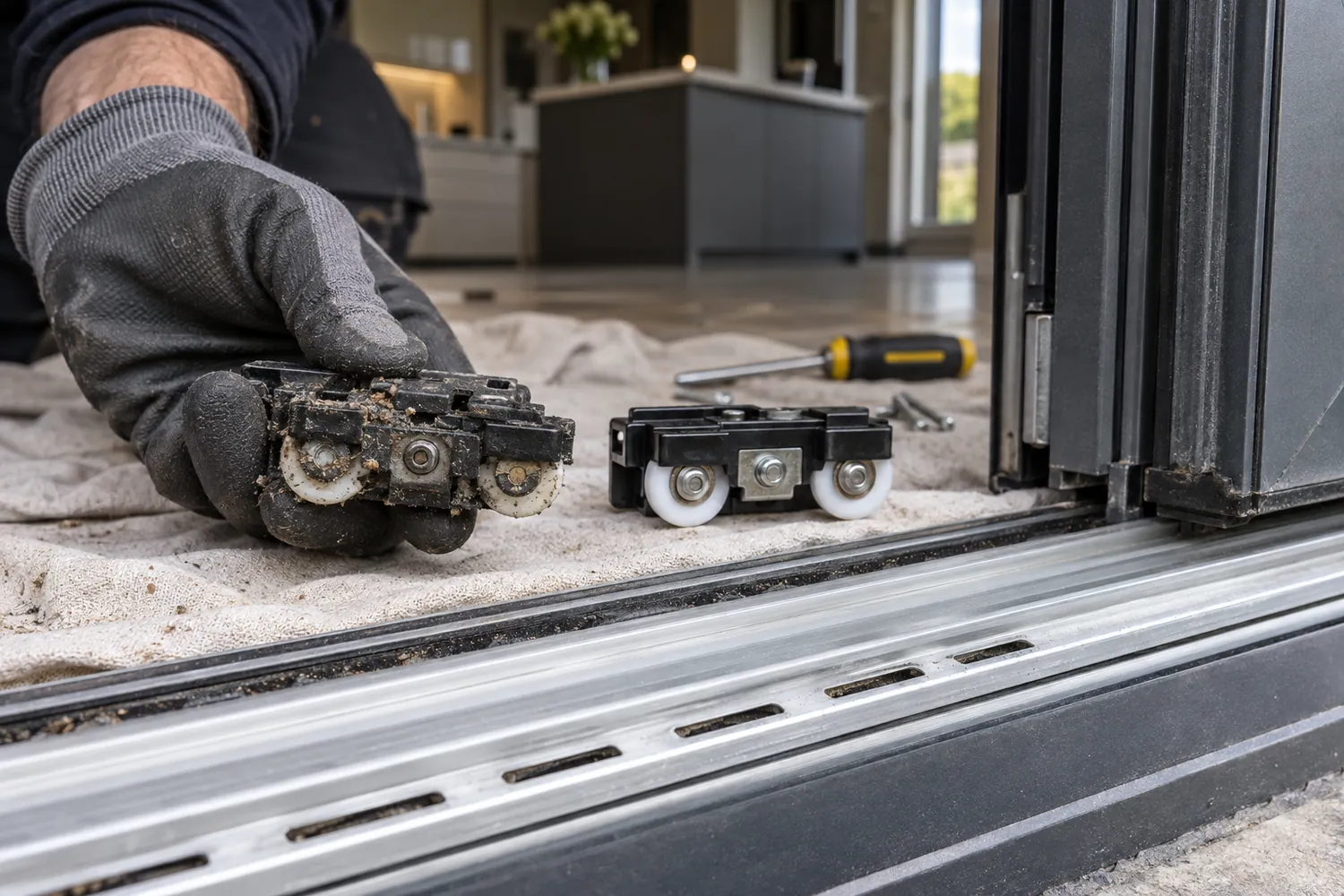
Wheels at the travelling end of each pair of leaves. Worn rollers are the most common cause of dragging.
3
Bottom track and threshold
Carries the weight on bottom-rolling systems and drains rainwater through slots in the threshold.
4
Intermediate hinges
Join the leaves so they fold. Worn or loose hinges let a leaf drop and throw the whole set out of line.
5
Jamb hinges
Hang the end leaves from the frame. If the frame moves, every leaf after it moves too.
6
Traffic door
The leaf you open day to day, like a normal door. It takes the most use and drops first.
7
Handle and multipoint gearbox
Drives the locking points on the traffic door. A stiff handle is usually misalignment, not a broken lock.
8
Shootbolts and keeps
Bolts that lock the non-opening leaf into the top and bottom tracks. A few millimetres of drop is enough to miss.
9
Glass packers (toe and heel)
Blocks that carry the glass in the frame. If one slips, the leaf sags from the inside — a job for a glazier.
Bottom-rolling
The leaves run on rollers in the bottom track; the top track only guides them. This is the most common layout on UK aluminium bifolds. Faults show up as dragging, grinding and dirt-related sticking, so a clean track matters most.
Top-hung
Carriages in the top track carry the full weight and the bottom only guides. These are kinder to a flush threshold but depend on a perfectly straight beam overhead. If the lintel deflects, the leaves bind at the top — adjustment can take up some of it, but not a sagging structure.
Worn rollers flatten and pick up grit. The leaf drops, drags and pulls its neighbours out of line.
Why millimetres matter
A few millimetres decide whether a bifold locks
Shootbolts and multipoint hooks engage keeps that are only slightly bigger than the bolt. Once a leaf drops by a few millimetres — from a worn roller, a loose hinge or a settling frame — the bolt starts hitting the edge of its keep. The handle gets heavier, then stops lifting at all.
Heat makes it worse. Aluminium grows by about 0.023 mm per metre for every degree Celsius, so a four-metre opening moves by around 3–4 mm between a cold morning and an afternoon in full sun. Dark anthracite frames move the most. That is why many sets that close fine in spring start catching in July.
Installers check that the frame diagonals match within about 2 mm when a set goes in. We check the same thing when it comes back out of line: whether the frame has moved, or only the leaves.
Before you call
Five safe checks — and four things not to do
Some sticking is simply dirt. These checks take ten minutes and cost nothing. If the door still drags or will not lock afterwards, it needs adjusting.
Safe to do yourself
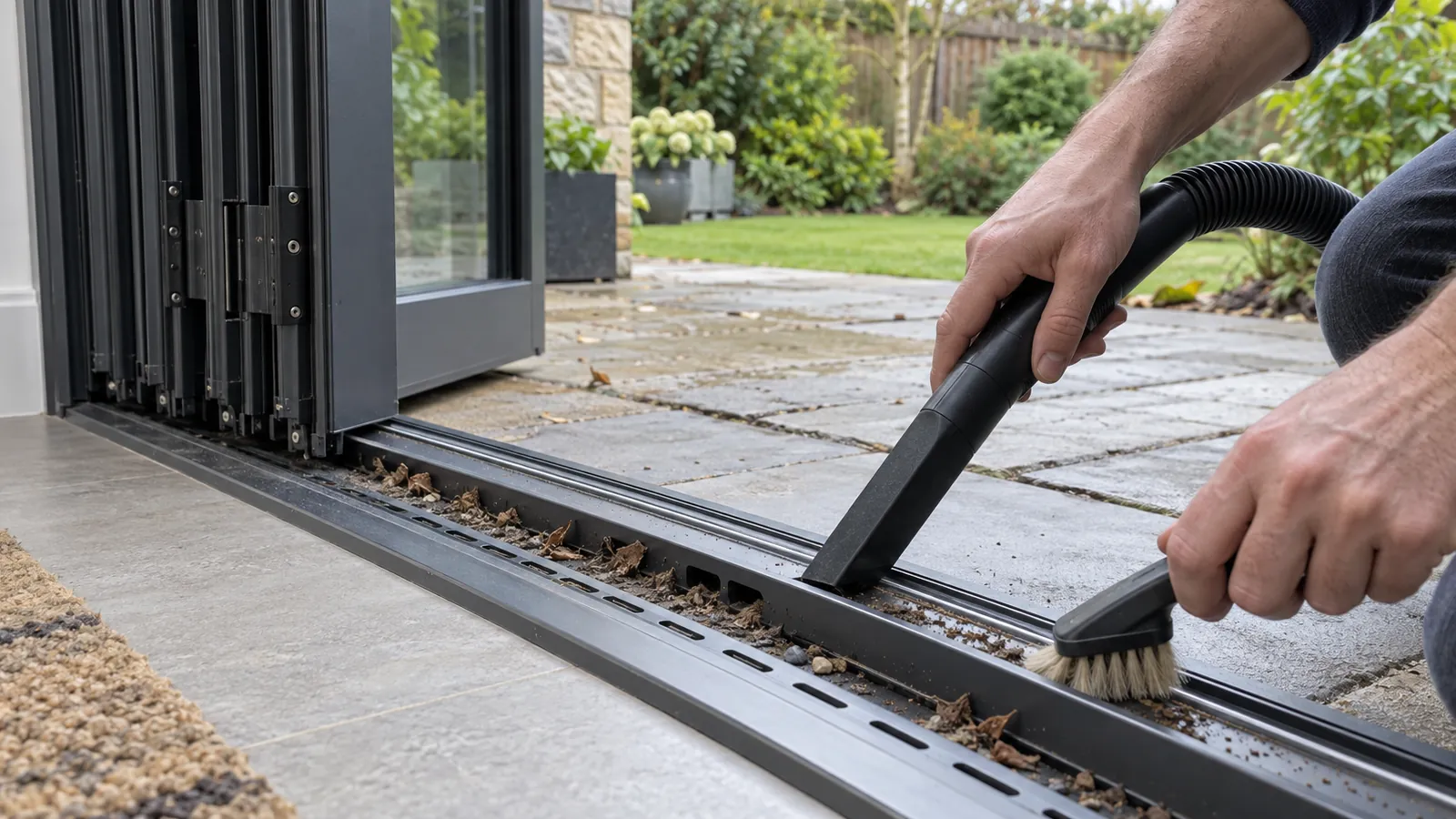
Vacuum the bottom track and wipe it with warm soapy water
Clear the drainage slots in the threshold with a soft brush
Tighten any screws you can see are loose on hinges or keeps
Spray rollers and hinges with silicone lubricant, then wipe off the excess
Open and close each leaf slowly and note where it catches
Please don't
Lift a leaf off the track — a glazed aluminium leaf can weigh 50–80 kg
Force a stiff handle — that is how gearboxes and spindles snap
Pack the track with grease — it holds grit and makes dragging worse
Keep using a leaf that hangs from one hinge — the next fold can bring it down
Grit in the bottom track is the cheapest bifold fault to fix — and the first thing to rule out.
Get a price on WhatsApp
Six photos that let us price your bifold repair
Most bifold faults can be identified before anyone visits. Send these, and Vitaly will reply with the likely cause and a price — usually within 30 minutes during working hours.
Closed, standing back far enough to see every leaf and the top and bottom tracks.
2
The problem leaf, close up
Where it rubs, gaps or will not bolt. Use the torch if the track is in shadow.
3
Bottom of the traffic door
The hinge, roller or shootbolt and the track underneath it.
4
Top track and carriage
Shows whether the system is top-hung or bottom-rolling.
5
Any name or stamp
On the hinges, handle, track end caps or a label on the frame edge. This identifies the system and its parts.
6
A short video
Ten seconds of opening and folding the set. The sound tells as much as the picture.
Systems and materials
Aluminium, uPVC and timber — and the systems behind them
Bifold hardware is system-specific: a hinge from one manufacturer rarely fits another, and some older systems are no longer made. That is why we identify the system from your photos before booking and confirm the part is available, rather than arriving to find out.
OriginSmart VisofoldSchücoAluKSunflexLiniarEurocellTimber and uPVC sets
Names are listed to help you identify your doors. LockMend is independent and not affiliated with any manufacturer.
Aluminium sets are the heaviest and the most sensitive to heat. uPVC sets are lighter but their profiles flex, so hinges work loose sooner. Timber sets move with moisture and need their clearances checked after a wet winter.
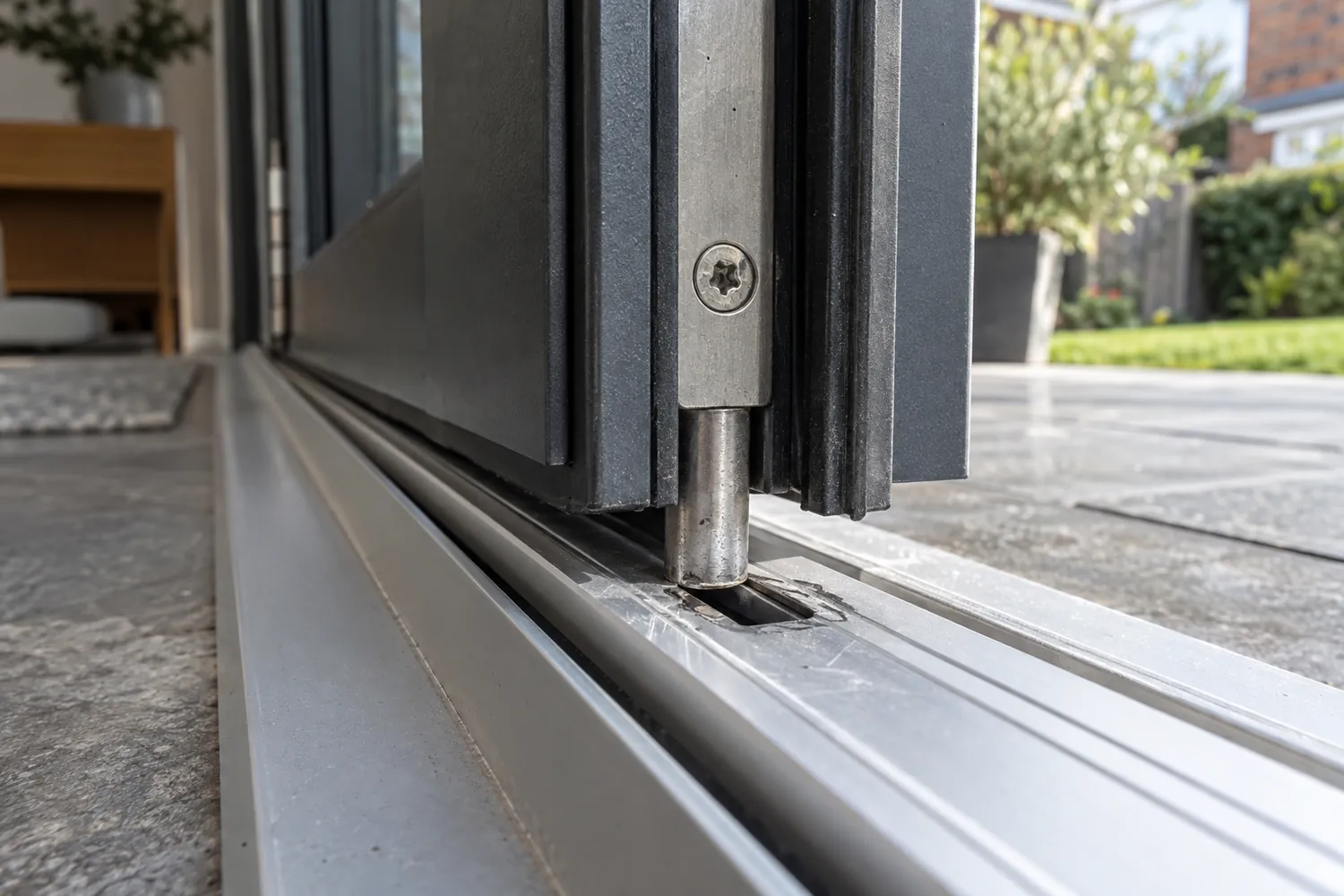
A shootbolt meeting its keep. When the leaf drops, the bolt lands on the edge instead of in the hole.
Repair vs replace
What we repair — and what a new set would cost
Bifold companies make their money on new doors, so a sticking set is often quoted for replacement. In most cases only a part has worn.
What LockMend repairs
Rollers and roller carriages
Intermediate and jamb hinges
Top and bottom track sections and guides
Shootbolts, keeps and magnetic catches
Multipoint gearbox, handles and cylinders on the traffic door
Full set realignment and seasonal clearance adjustment
What we don't do
Sealed glass units — we tell you if one has failed and point you to a glazier
New bifold door sets — we do not sell them, so the advice stays independent
Rebuilding a distorted frame or structural lintel work
Typical cost — repairing a bifold set vs replacing it
Realignment and adjustment of the setFrom £120
Roller, hinge, track or lock part replacedFrom £130
New 3-panel aluminium bifold, supplied and fitted£3,150–£4,650
Replacement only makes sense when the frame is distorted beyond its adjustment range, a profile is physically damaged, or the system is obsolete with no compatible part. If that is the case, we tell you before you spend anything with us.
Transparent pricing
Bifold door repair prices
Prices include labour and a standard part. Parts made for one specific system are priced from your photos before the visit.
ServiceTypical cost
Clean, adjust and realign a bifold setFrom £120
Roller or carriage replacementFrom £130
Hinge replacementFrom £130
Shootbolt, keep or gearbox replacement on the traffic doorFrom £130
Handle or cylinder on the traffic doorPriced from photos
How it works
From photos to a bifold that folds, slides and locks
01
Send photos or call
WhatsApp the six photos above, or call and describe what the door is doing.
02
Price before the visit
You get the likely fault and the price. If your system needs a specific part, we confirm we can get it first.
03
Repair and test
Every leaf is opened, folded, closed and locked before we leave — not just the one that was sticking.
04
Pay on completion
Card, cash or bank transfer. 12-month parts-and-labour warranty. Covers LockMend's work and the parts LockMend supplies.
Keep it running
A simple bifold maintenance routine
Most of the bifold faults we repair started as dirt or a small drop that nobody noticed. This routine catches both early.
WhenWhat to do
Every monthVacuum the bottom track and clear the drainage slots.
Every 6 monthsSilicone spray on rollers and hinges; check for loose screws; test every lock.
Every yearProfessional adjustment if gaps have changed or the handle feels heavier.
Before winterCheck the gaskets close evenly — a draught now means the leaves have moved.
Straight answers on cost, causes, systems and what you can safely check yourself.
How much does bifold door repair cost in Manchester?
At LockMend, bifold realignment and adjustment starts from £120, and replacing a roller, hinge, track section or lock part starts from £130 including a standard part. Parts made for one specific system are priced from your photos before the visit. There is no call-out fee and the price is agreed before any work starts. For comparison, a new three-panel aluminium bifold set typically costs £3,150–£4,650 supplied and fitted (MyJobQuote UK cost guide, September 2026).
Why is my bifold door dragging on the bottom track?
The usual causes, in order of how often we find them: grit or debris in the bottom track, worn or collapsed rollers, a leaf that has dropped because a hinge or carriage has worn or worked loose, and on top-hung systems a head or lintel that has deflected under load. Aluminium also expands in hot weather, so a set with little clearance can start rubbing in summer. Clean the track first; if it still drags, the leaf needs adjusting or a roller replacing.
Why won't my bifold door lock?
Most often the traffic (main opening) door has dropped by a few millimetres, so the top and bottom shootbolts no longer line up with their keeps and the handle feels stiff or will not lift. Less often the multipoint gearbox inside the traffic door has failed, or a keep has moved. Do not force the handle — that can snap the gearbox or spindle. Realigning the leaf and resetting the keeps fixes most cases.
Can a dropped bifold door be realigned instead of replaced?
Usually, yes. Most bifold systems are designed to be adjusted: carriages, hinges and keeps all have adjustment, and worn rollers and hinges are replaceable parts. Replacement only makes sense when the frame is distorted beyond the adjustment range, an aluminium profile is physically damaged, or the system is obsolete and no compatible part exists. We tell you which applies before any money is spent.
How do I know if my bifold doors are top-hung or bottom-rolling?
Look at where the wheels carry the weight. If the panels run on wheels in the bottom track and the top track only guides them, the system is bottom-rolling — the most common type on UK aluminium bifolds. If carriages in the top track carry the panels and the bottom only guides them, it is top-hung, and the beam above the opening must stay straight. A photo of the top and bottom of one panel is enough for us to tell.
Which bifold door systems do you repair?
We see aluminium, uPVC and timber bifolds, including common UK systems such as Origin, Smart Visofold, Schüco, AluK, Sunflex, Liniar and Eurocell. Parts are not always interchangeable between systems, so we confirm the system and part availability from photos of the hinge, handle or frame label before booking. LockMend is independent and not affiliated with any door manufacturer.
How long does a bifold door repair take?
Cleaning, adjustment and realignment are usually done in one visit. Replacing rollers, hinges or a gearbox is also one visit when the part is available for your system. If a system-specific part has to be ordered, we say so before booking and return to fit it.
Can I fix a sticking bifold door myself?
Some checks are safe: vacuum and wipe the bottom track, clear the drainage slots, tighten any visibly loose screws, and apply a silicone spray to rollers and hinges. Avoid heavy grease in the track because it holds grit. Do not lift a leaf off its track — a glazed aluminium leaf can weigh 50–80 kg — and do not force a stiff handle. If the door still drags or will not lock, it needs adjusting.
Why do my bifold doors stick in summer?
Aluminium expands by about 0.023 mm per metre for every degree Celsius. Across a four-metre opening and a 40 °C swing between a cold morning and a frame in direct sun, that is around 3–4 mm — enough to close a tight gap. Dark anthracite frames heat up more than white ones. A set that only sticks in hot weather usually needs its clearances adjusted rather than new parts.
Do you replace bifold glass or fit new bifold doors?
No. LockMend repairs the working parts — rollers, carriages, hinges, tracks, shootbolts, keeps, gearboxes, handles and adjustment. We do not supply new door sets or replace sealed glass units. If the inspection shows the glass has slipped on its packers or a unit has failed, we tell you before any work and point you to a glazier.
Is there a warranty on bifold door repairs?
Yes. 12-month parts-and-labour warranty. Covers LockMend's work and the parts LockMend supplies. If a part we supply fails because of a defect, or a fault is caused by our work within 12 months, we put it right at no charge.
What areas and hours do you cover for bifold repairs?
LockMend covers Sale, Greater Manchester and nearby Cheshire, including Sale, Altrincham, Hale, Bowdon, Timperley, Didsbury, Stretford and Urmston. Working hours are Every day 06:00–21:30; we do not take jobs after 21:30. You speak directly to Vitaly, who carries out the repair.
Bifold door sticking or not locking in Greater Manchester?
Send photos or call. You get the likely fault and a price before anyone visits — no call-out fee.